fmt-zoned-datetime 🚧
Warning
This function is experimental and can change at any time.
let fmt-zoned-datetime(
  dt,
  zone,

  locale: "en",
  fallback: "localized-gmt",
  date-length: "long",
  time-length: "long"
)
Formats a date and a time in a timezone. Dates are assumed to be ISO dates.
Arguments
dt
The date and time to format. This can be a datetime or a dictionary with year, month, day, hour, minute, and second.
Example
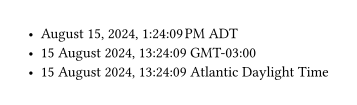
#let tz = (
  offset: "-03",
  iana: "America/Thule",
  zone-variant: "dt",
)

- #fmt-zoned-datetime(datetime(
  year: 2024, month: 8, day: 15,
  hour: 13, minute: 24, second: 9
), tz)
- #fmt-zoned-datetime(( // (1)!
    year: 2024, month: 8, day: 15,
    hour: 13, minute: 24, second: 9
  ),
  tz,
  locale: "en-GB"
)
- #fmt-zoned-datetime((
    year: 2024, month: 8, day: 15,
    hour: 13, minute: 24, second: 9
  ),
  tz,
  locale: "en-GB",
  time-length: "full"
)
- Datetime passed as a dictionary

zone
The timezone. A dictionary with offset, iana, bcp47, metazone-id, and zone-variant. The options correspond to the arguments for fmt-timezone. Only offset is mandatory - the other fields provide supplemental information for named time zones.
iana and bcp47 are mutually exclusive. To get the zone name, iana/bcp47 and zone-variant must be specified in addition to offset. Note that not every locale has names for the zones. If a zone doesn't have a name in some locale, fallback is used.
Example
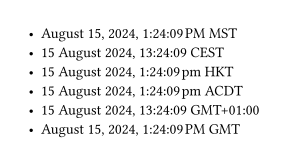
#let dt = datetime(
  year: 2024, month: 8, day: 15,
  hour: 13, minute: 24, second: 9
)

- #fmt-zoned-datetime(dt, (
  offset: "-07",
  iana: "America/Phoenix",
  zone-variant: "st",
))
- #fmt-zoned-datetime(dt, (
  offset: "+02",
  iana: "Atlantic/Jan_Mayen",
  zone-variant: "dt",
), locale: "en-GB")
- #fmt-zoned-datetime(dt, (
  offset: "+08",
  iana: "Asia/Hong_Kong",
  zone-variant: "st",
), locale: "en-HK")
- #fmt-zoned-datetime(dt, (
  offset: "+09:30",
  iana: "Australia/Adelaide",
  zone-variant: "dt",
), locale: "en-AU")
- #fmt-zoned-datetime(dt, (
  offset: "+01",
  iana: "Europe/Belfast", // (1)!
), locale: "en-GB")
- #fmt-zoned-datetime(dt, (
  offset: "Z",
))
- No
zone-variantspecified.

locale
The locale to use when formatting the zoned datetime. A Unicode Locale Identifier. As with dates, ca can be set to a bcp47 calendar name.
Example
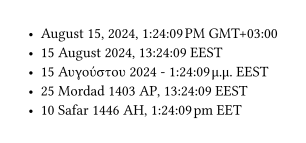
#let dt = datetime(
  year: 2024, month: 8, day: 15,
  hour: 13, minute: 24, second: 9
)

#let tz = (
  offset: "+03",
  iana: "Asia/Nicosia",
  zone-variant: "dt",
)

- #fmt-zoned-datetime(dt, tz)
- #fmt-zoned-datetime(
    dt, tz,
    locale: "en-GB"
  )
- #fmt-zoned-datetime(
    dt, tz,
    locale: "el-CY"
  )
- #fmt-zoned-datetime(
    dt, tz,
    locale: "en-GB-u-ca-persian"
  )
- #fmt-zoned-datetime(
    dt, tz,
    locale: "en-GB-u-ca-islamic-hc-h12"
  )

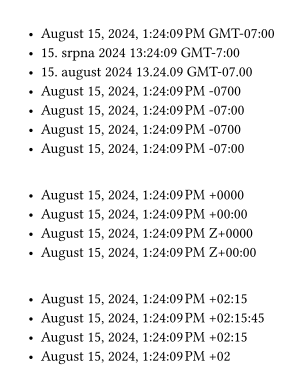
fallback
The timezone format fallback. Either "localized-gmt" or a dictionary for an ISO 8601 fallback. This has the same effect as fallback does for fmt-timezone.
Example
#let dt = datetime(
  year: 2024, month: 8, day: 15,
  hour: 13, minute: 24, second: 9
)

#let f(
  offset,
  iso: none,
  minutes: true,
  seconds: false,
  locale: "en"
) = fmt-zoned-datetime(
  dt,
  (offset: offset), // timezone
  fallback: if iso != none {(
      iso8601: (
        format: iso,
        minutes: if minutes {
          "required"
        } else {
          "optional"
        },
        seconds: if seconds {
          "optional"
        } else {
          "never"
        },
      )
  )} else {
    "localized-gmt"
  },
  locale: locale,
)

- #f("-07")
- #f("-07", locale: "cs")
- #f("-07", locale: "da")
- #f("-07", iso: "basic")
- #f("-07", iso: "extended")
- #f("-07", iso: "utc-basic")
- #f("-07", iso: "utc-extended")
\
- #f("Z", iso: "basic")
- #f("Z", iso: "extended")
- #f("Z", iso: "utc-basic")
- #f("Z", iso: "utc-extended")
\
// 2h 15min 45s
#let sec = (2 * 60 * 60) + (15 * 60) + 45
- #f(sec, iso: "extended")
- #f(sec, iso: "extended", seconds: true)
- #f(sec, iso: "extended", minutes: false)
- #f(2 * 60 * 60, iso: "extended", minutes: false)

date-length
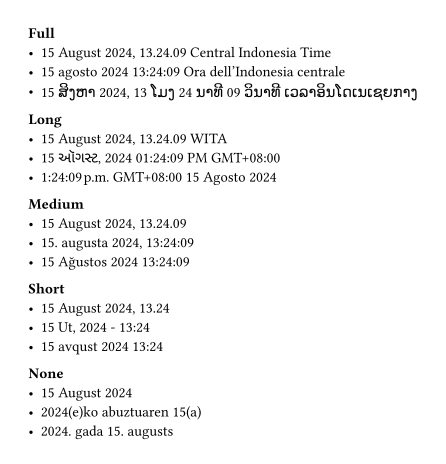
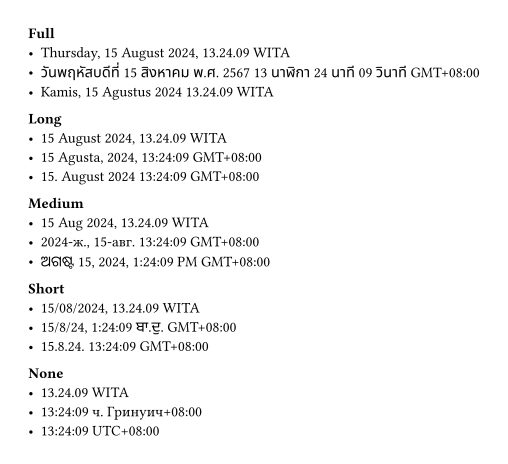
The length of the formatted date part ("full", "long" (default), "medium", "short", or none).
Example
#let dt = datetime(
  year: 2024, month: 8, day: 15,
  hour: 13, minute: 24, second: 9
)

#let tz = (
  offset: "+08",
  iana: "Asia/Makassar",
  zone-variant: "st",
)

#let f(
  date-length,
  locale: "en"
) = fmt-zoned-datetime(
  dt, tz,
  date-length: date-length,
  locale: locale
)

*Full*
- #f("full", locale: "en-ID")
- #f("full", locale: "th")
- #f("full", locale: "id")

*Long*
- #f("long", locale: "en-ID")
- #f("long", locale: "ha")
- #f("long", locale: "lb")

*Medium*
- #f("medium", locale: "en-ID")
- #f("medium", locale: "ky")
- #f("medium", locale: "or")

*Short*
- #f("short", locale: "en-ID")
- #f("short", locale: "pa")
- #f("short", locale: "sr")

*None*
- #f(none, locale: "en-ID")
- #f(none, locale: "bg")
- #f(none, locale: "fr")

time-length
The length of the formatted time part ("full", "long" (default), "medium", "short", or none).
Example
#let dt = datetime(
  year: 2024, month: 8, day: 15,
  hour: 13, minute: 24, second: 9
)

#let tz = (
  offset: "+08",
  iana: "Asia/Makassar",
  zone-variant: "st",
)

#let f(
  time-length,
  locale: "en"
) = fmt-zoned-datetime(
  dt, tz,
  time-length: time-length,
  locale: locale
)

*Full*
- #f("full", locale: "en-ID")
- #f("full", locale: "it")
- #f("full", locale: "lo")

*Long*
- #f("long", locale: "en-ID")
- #f("long", locale: "gu")
- #f("long", locale: "qu")

*Medium*
- #f("medium", locale: "en-ID")
- #f("medium", locale: "sk")
- #f("medium", locale: "tr")

*Short*
- #f("short", locale: "en-ID")
- #f("short", locale: "wo")
- #f("short", locale: "az")

*None*
- #f(none, locale: "en-ID")
- #f(none, locale: "eu")
- #f(none, locale: "lv")